


How to Be More Aware of Your Thoughts and Stop Living on Autopilot (The First Step to Real Change)

Summary: How to Be More Aware of Your Thoughts and Stop Living on Autopilot
(The First Step to Real Change)
Learning how to be more aware of your thoughts is not complicated, but it is the most important skill you can build if you are trying to change patterns that keep repeating. Most of our thoughts and actions happen automatically, often before we are fully conscious of them. This is why it can feel like we are reacting in real time, when in reality much of the process has already been set in motion.
Building self-awareness changes where decisions actually happen. Instead of noticing behavior after it plays out, you begin to see it as it is unfolding, which creates the ability to respond differently.
This is the starting point for changing patterns that would otherwise continue on autopilot indefinitely.
In this post, we’ll explore:
- Why we default to autopilot more than we realize
- The signs you are living on autopilot
- How awareness changes behavior before it fully plays out
- What it actually means to notice your thoughts in real time
- A simple way to start building thought awareness in your daily life
Becoming aware of your thoughts allows you to interrupt automatic patterns before they turn into actions. This is what makes self-awareness the foundation for meaningful, lasting change.
“Between stimulus and response there is a space. In that space is our power to choose our response.”
— Viktor Frankl
Why We Keep Living on Autopilot Without Realizing It
There are moments in everyday life that feel small on the surface but reveal something significant when you actually look at them.
At times I catch myself sitting across from someone in a conversation, nodding, making the right sounds at the right intervals, and somewhere around the third or fourth minute realizing I had absolutely no idea what they had just said. My eyes were on them. My body was oriented toward them. Everything about my posture suggested I was present. But I had left the conversation at some point and never consciously decided to go.
That is the strange thing about autopilot. You do not decide to check out. You do not decide to reach for your phone, snap at someone you care about, or fall back into the habit you promised yourself you were done with. By the time you notice, it has already happened. The decision you thought you were making in real time had already begun somewhere earlier, quietly, without asking for your input.
At first, noticing this is frustrating. It can feel like you have less control than you thought. But if you stay with it, something shifts. Because the moment you catch it, even after the fact, is the moment awareness begins. And awareness is the only place where real change has any room to start.
Why the Mind Defaults to Autopilot
The mind is constantly looking for efficiency. Every day we have a limited amount of cognitive energy, and if every action required full conscious attention, even simple tasks would become exhausting. So the brain forms patterns through repetition and carries them forward automatically. We call these habits, and they are not a design flaw. They are a feature.
In the beginning, a new pattern requires deliberate effort. You are learning something unfamiliar, so every step demands attention. Over time it becomes easier. Eventually it runs without needing your involvement at all. This is what allows us to drive, cook, and carry on a conversation simultaneously. But it is also why certain behaviors feel so stubbornly difficult to change.
When a pattern is already running before you become aware of it, it no longer feels like a pattern. It feels like a decision you are actively making. From the inside, it is genuinely hard to tell the difference. We assume that if something feels like a choice, it must be one. But in many cases, we are stepping into a process that started several seconds, sometimes several minutes, before we became conscious of it.
The Signs You Are Living on Autopilot
One of the reasons living on autopilot is so easy to miss is that it does not look like disengagement from the outside. It can look like a perfectly normal day. Here are some of the most common signs that automatic behavior is running more of your life than you realize:
You reach the end of the day and cannot account for where the time went. You were busy, but you are not sure what you actually accomplished or chose to do. The day moved and you moved with it.
You react before you think. Someone says something and you respond with irritation, defensiveness, or withdrawal before any conscious decision was made. You notice how you responded after the fact, not during.
You check your phone without deciding to. This is one of the clearest everyday examples. The action happens before the thought. You are looking at a screen and you are not entirely sure when you picked it up.
You keep returning to a behavior you have decided to change. Not because you forget your intention, but because the pattern starts before the intention has a chance to surface. The habit runs, and the awareness arrives late.
You find yourself somewhere in a conversation or task and realize you stopped paying attention. Like the example above. You are present in body and absent in attention, and the absence happened gradually without announcement.
None of these are signs of weakness or poor discipline. They are signs of a well-trained autopilot doing exactly what it was built to do. The question is whether that autopilot is running in a direction you have actually chosen.
Where We Usually Try to Change Things
When something is not working, the instinct is to focus on the outcome and try to correct it. We replay the situation, think about what we should have done differently, and plan how we will respond next time. All of that feels productive, and to some extent it is.
But it happens after the most important moment has already passed.
By the time we are reflecting, the pattern has already run its course. This is why change often feels inconsistent. We are adjusting the result without seeing where the pattern actually begins. We are editing the final chapter and wondering why the story keeps going the same way.
What is missing is earlier awareness, catching the pattern as it starts rather than after it has already finished.


How Awareness Changes Behavior Before It Happens
Awareness does not change what has already happened. It changes when you begin to see what is happening.
Instead of noticing a reaction after it has played out, you begin to notice it as it forms. Instead of realizing you have been distracted for ten minutes, you catch the moment your attention starts to drift. Instead of being carried by an emotion, you recognize the first signs of it building and you have, for a moment, a choice about what happens next.
That shift is subtle. It may not feel significant the first time it happens. But it is the entire foundation of what comes after it. Viktor Frankl described it this way:
“between stimulus and response there is a space, and in that space is our power to choose.”
Most of us do not experience that space because we are not aware of it. Awareness is what makes it visible.
What It Means to Be More Aware of Your Thoughts
At its most basic level, being aware of your thoughts means noticing them as they appear rather than being carried by them without realizing it.
It means noticing when your attention shifts before you are already somewhere else entirely. It means catching a thought as it forms rather than discovering it after it has shaped how you felt or what you said. It means being a step behind the pattern at first, then eventually alongside it, then eventually just ahead of it.
This is not the same as controlling your thoughts or forcing them to be positive. Thought awareness is not thought control. It is simply the practice of seeing what is already happening with enough clarity that you are no longer completely inside it.
When I started paying attention to moments like that conversation I had checked out of, what I noticed first was how late I was catching things. Way after the fact. Then a little less late. Then sometimes, in smaller moments, almost in real time. That gap does not close overnight, but it does close. And every time it does, there is a little more room to choose differently.
A Simple Way to Be More Present in Daily Life
There is no need for a complicated system to begin. The only requirement is interruption.
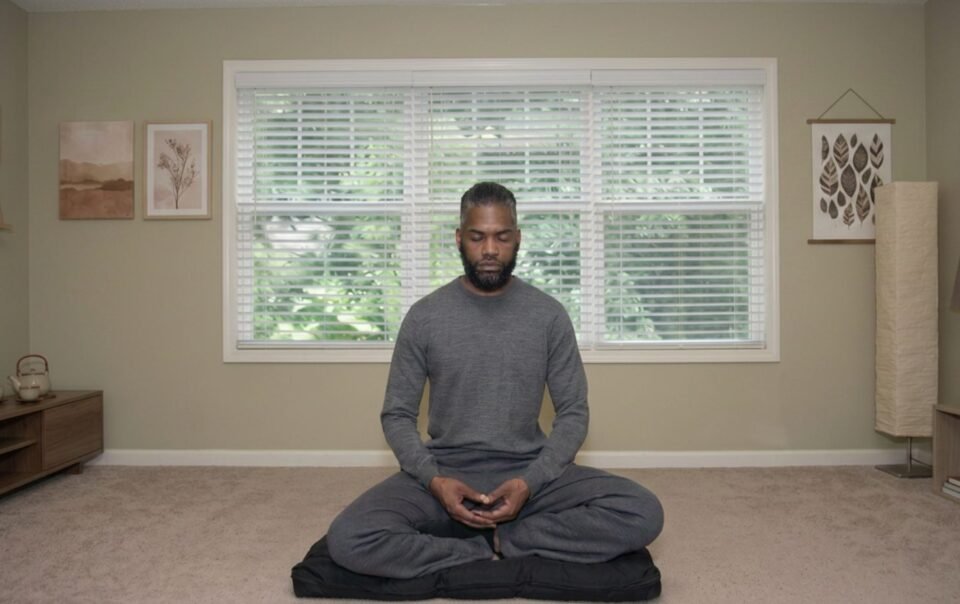
At different points throughout the day, pause and ask yourself one question: “What is happening right now?”
The value of that question is not in the words. It is in what the question creates. It interrupts whatever is currently running and brings attention back to the present moment. From there you can notice where your attention actually is, what you are thinking about, what you are feeling, and what you are about to do next.
In the beginning, nothing dramatic changes. The same patterns are still there. But you are no longer fully inside them. You are a few steps back, watching them from a small but real distance. And that distance, however small, is where everything starts.

A Perspective That Has Been Around Longer Than We Think
William James, one of the founding figures of modern psychology, wrote extensively about the relationship between attention and habit in the late 1800s. His central observation was that automatic behavior does not mean uncontrollable behavior. It means behavior that runs without the involvement of conscious attention.
His insight was simple and it holds up: when attention is absent, patterns continue. When attention is present, those patterns become visible. And what is visible can be worked with in a way that what is invisible cannot.
This is not a new idea. Contemplative traditions across cultures have pointed at the same thing for centuries. The specific language differs but the observation is consistent: most of what runs our lives operates below the level of awareness, and becoming aware of it is the first and most important step toward changing it.
You do not need to master this immediately. You just need to start seeing what is already happening.
Where This Fits in The Change System
Learning how to be more aware of your thoughts is the first step in the system because without it, nothing else has firm ground to stand on. If we cannot see what is happening, we cannot work with it in a meaningful way. We can try to change behavior directly, but it will feel unstable, because the underlying process continues untouched.
When self-awareness improves, everything that follows becomes more accessible. We begin to see how thoughts form, how reactions build, and how decisions actually unfold. From there, each step in the system has something real to build on rather than trying to change outcomes from the outside.
Frequently Asked Questions
Why does it feel like things happen before I decide?
Because many patterns begin automatically. By the time we notice them, we are already partway through the process. The behavior started before conscious awareness caught up.
How do I become more aware of my thoughts?
By noticing them as they appear rather than trying to control them. Awareness grows through observation, not force. A simple pause during the day, asking “what is happening right now,” is enough to begin.
What does living on autopilot actually mean?
It means that a significant portion of your thoughts, reactions, and behaviors are running on established patterns rather than conscious choice. It is not a flaw. It is how the brain conserves energy. The problem is when those automatic patterns are carrying you somewhere you would not choose to go if you were paying attention.
Does awareness actually lead to change?
Yes. It changes when you see what is happening, and that shift creates space for different responses. You cannot change a pattern you cannot see. Awareness does not guarantee change, but nothing meaningful changes without it.
How long does it take to become more self-aware?
There is no fixed timeline. Most people notice a shift within a few weeks of practicing consistent interruption, simply pausing and asking what is actually happening. The gap between the pattern starting and you noticing it tends to close gradually. Progress is real but it is quiet, which is why it is easy to underestimate how far you have come.
Is this the same as mindfulness?
Mindfulness is a practice that develops awareness. Awareness is what mindfulness practice is building toward. They are related but not identical. You do not need a formal mindfulness practice to develop thought awareness. You just need to start noticing more often.
Final Thoughts
Most of what runs our lives happens before we know it is happening. That is not a personal failure. It is just how the mind works when attention is elsewhere. The only way to change patterns that operate below awareness is to bring them into it, one moment at a time, without forcing anything and without expecting it to be dramatic. The shift is quiet. You catch something you would have missed before. You notice yourself mid-pattern instead of after it. You have a moment of choice that did not exist last week. That is what awareness does. It does not fix everything at once. It just keeps giving you more moments where you could choose differently, and over time, that changes everything.
Note:
This post is part 1 of the “Alignment Series”. To see the rest of the series check out the next post “How to Stay Consistent Without Motivation (What Actually Works)”.